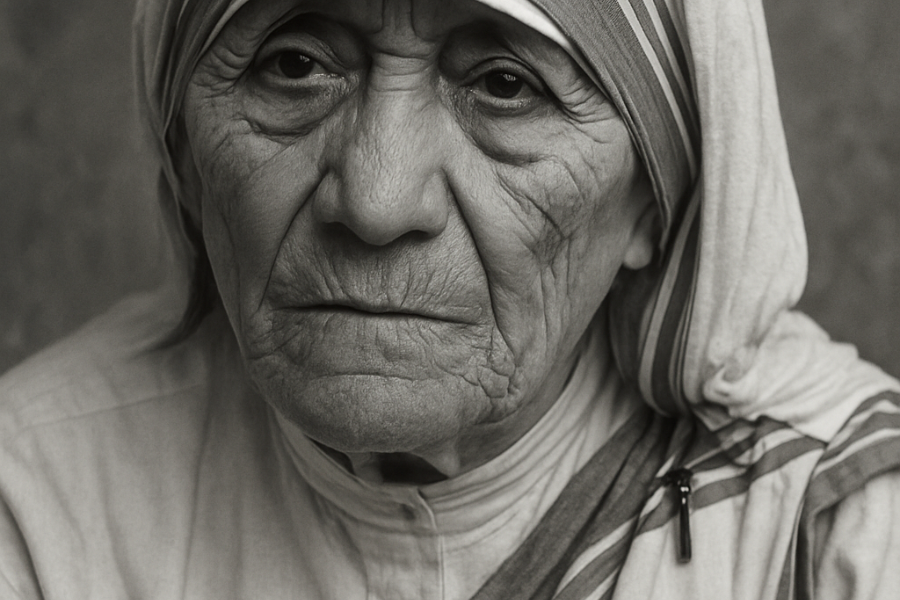
Few figures in modern history have embodied the Gospel as powerfully as Saint Teresa of Calcutta. Known to the world as Mother Teresa, she dedicated her life to serving Christ among the poorest of the poor. Her simple sari, her worn hands, and her radiant smile became symbols of God’s love reaching into the darkest places of human suffering. Today, she is a Catholic saint, a Nobel Peace Prize winner, and a global symbol of compassion. But beyond the titles and recognition, her story reflects obedience to God’s call, deep humility, and love in action. Let us explore her life in detail and consider how her example continues to inspire the Church and the world.
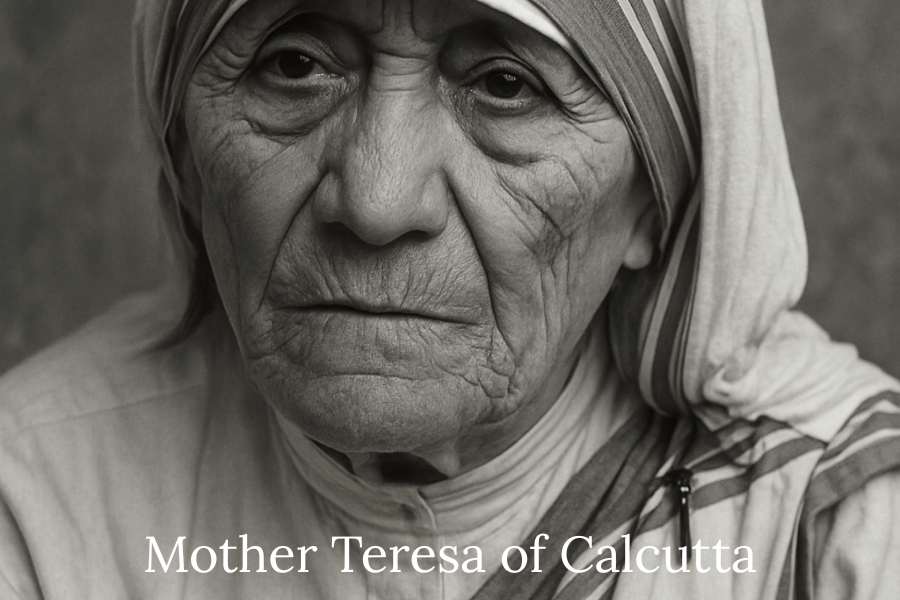
Early Life: From Skopje to the World
Saint Teresa of Calcutta was born Anjezë Gonxhe Bojaxhiu on August 26, 1910, in Skopje. At that time, it was part of the Ottoman Empire and is now the capital of North Macedonia.
Her family was Albanian and deeply Catholic. Her father, Nikola, was a successful businessman, while her mother, Dranafile, was a devout and generous woman. Dranafile taught her children to recognize the needs of others, often saying, “My child, never eat a single mouthful unless you are sharing it with others.”
This spirit of generosity shaped young Anjezë’s heart. By the age of twelve, she already felt the call to a religious life.
The Call to Religious Life
At eighteen, she made the brave choice to leave her family and homeland to follow her calling. She joined the Institute of the Blessed Virgin Mary (Loreto Sisters) in Dublin, Ireland. There, she took the name Sister Mary Teresa in honor of Saint Thérèse of Lisieux, the “Little Flower.” In 1929, Sister Teresa was sent to India to start her novitiate in Darjeeling. She learned Bengali and immersed herself in Indian culture. Soon after, she began teaching at St. Mary’s School in Calcutta, where she would spend nearly twenty years shaping the lives of young people. Her teaching years showed her skills in leadership, organization, and a deep love for children. However, even in those early days, she could not ignore the overwhelming poverty and suffering just outside the convent walls.
The “Call Within a Call”
On September 10, 1946, while traveling by train to a retreat in Darjeeling, Sister Teresa felt what she later described as a “call within a call.” She heard Christ urging her to leave the comfort of her convent life and serve Him directly in the slums of Calcutta. She saw this moment as a clear command: to quench Jesus’ thirst by caring for the poorest of the poor. This was a big decision. It meant leaving her community, her job as a teacher, and her familiar way of life. After years of reflection and with the Vatican’s permission, she stepped into the streets in 1948. She wore a simple white cotton sari with a blue border. This outfit would become a symbol of her mission.
Founding of the Missionaries of Charity
In 1950, Mother Teresa started the Missionaries of Charity, a religious group focused on helping “the poorest of the poor.” It began with just twelve sisters and has grown into an order with thousands of members worldwide. Their mission was simple but powerful: To feed the hungry, care for the sick, house the homeless, offer dignity to the dying, see Christ in every person, especially in those whom the world rejected. The sisters opened hospices for the dying, orphanages for abandoned children, and homes for lepers. They went into places others avoided and reached out to those others ignored, bringing hope to the most desperate situations.
Seeing Christ in the Poor
At the heart of Mother Teresa’s spirituality was a simple but profound truth: “Each one of them is Jesus in disguise.” When she picked up a man dying on the streets, she wasn’t just helping a stranger. She was serving Christ Himself. This vision gave her extraordinary courage to venture where others would not. Her teachings continue to challenge us today: “If you can’t feed a hundred people, then feed just one.” “Not all of us can do great things. But we can do small things with great love.” “The hunger for love is much more difficult to remove than the hunger for bread.” Her wisdom showed that true holiness is not about doing extraordinary deeds. It is about doing ordinary things with extraordinary love.
Recognition and the Nobel Peace Prize
The world could not ignore the quiet strength of her witness. In 1979, she received the Nobel Peace Prize. Instead of focusing on herself, she redirected the attention to Christ and the poor. In her acceptance speech, she boldly stated, “The greatest destroyer of peace today is abortion, because it is a direct war, a direct killing, direct murder by the mother herself.” Her words shocked many, but they showed her unwavering commitment to the dignity of all human life, from the unborn to the dying.
The Dark Night of the Soul
One of the most surprising discoveries about Mother Teresa came after her death in 1997. Her private letters revealed that she experienced a “dark night of the soul” for decades. She felt deep spiritual emptiness and a painful distance from God. Yet, even in this darkness, she carried on with her mission. She never stopped praying, never turned away from the poor, and never lost faith in Christ. This hidden struggle reveals that holiness is not about always feeling comforted. It’s about staying committed to love, even when God seems silent.
Canonization: Saint Teresa of Calcutta
Mother Teresa died on September 5, 1997, in Calcutta. Millions mourned her, and India honored her with a state funeral. In 2003, Pope John Paul II beatified her. Then in 2016, Pope Francis canonized her as a saint. Her feast day is celebrated on September 5, the anniversary of her death. Today, her group, the Missionaries of Charity, carries on her work in over 130 countries. They serve the poor, the dying, and the forgotten.
Why Mother Teresa Matters Today
Mother Teresa’s life offers lessons that are just as important today as they were in her time. Holiness is found in love. We don’t need to be missionaries in distant places to follow her example. We can serve Christ in our families, churches, and communities. Every person has dignity. From the unborn child to the homeless person, each life shows God’s image. Faith persists through challenges. Her hidden struggles remind us that true faith lasts even when we don’t feel God’s presence. Her message is simple but bold: “If you want to change the world, go home and love your family.”